
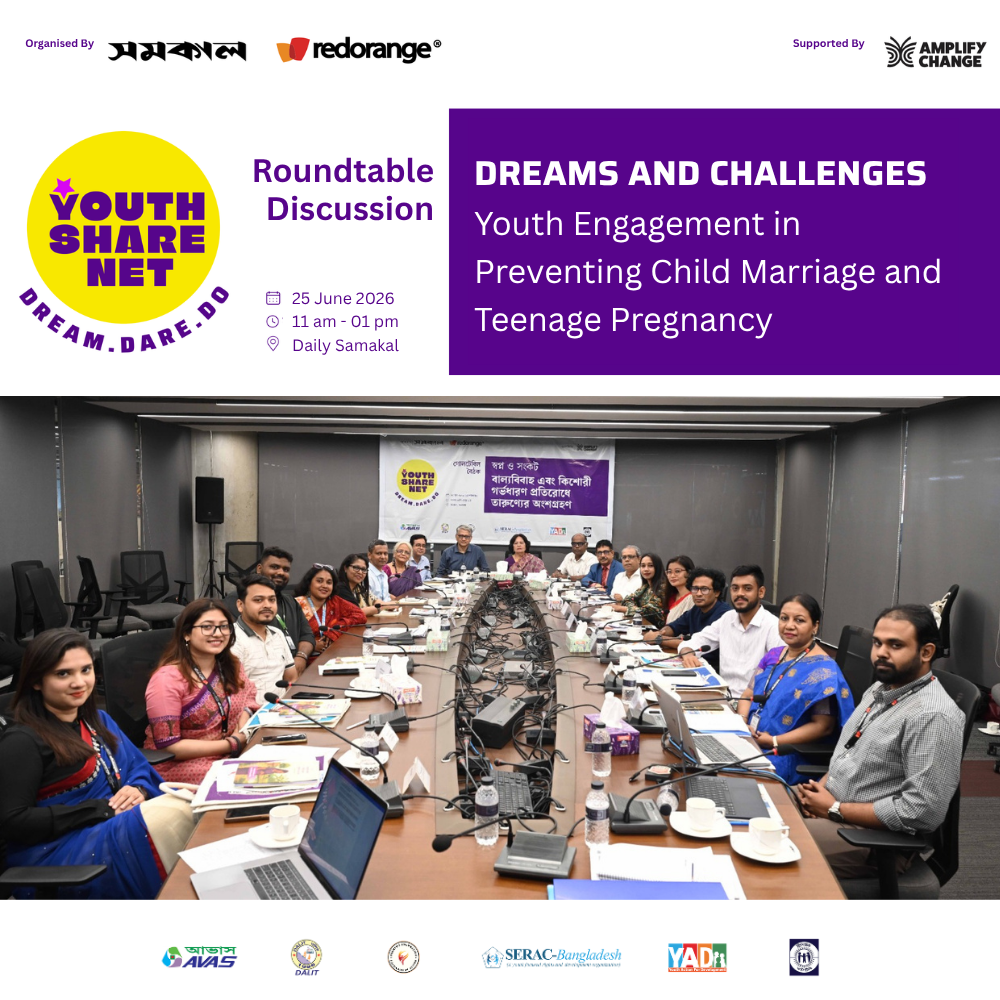
DREAMS AND CHALLENGES: Roundtable Discussion on Preventing Child Marriage and Teenage Pregnancy
Real change rarely begins in conference rooms. More often, it starts in villages, schools, youth clubs, and community gatherings where young people dare to ask difficult questions. Across Bangladesh, those conversations are becoming impossible to ignore. The challenge now is whether national policies can finally catch up with the realities young people live every day.
That question sits at the heart of the upcoming roundtable, “Dreams and Challenges: Youth Engagement in Preventing Child Marriage and Teenage Pregnancy,” organised by RedOrange Limited and The Daily Samakal, with support from the Youth Share-Net project and AmplifyChange.
The discussion builds on three Divisional SRHR Knowledge Fairs held in Mymensingh, Chattogram, and Khulna during 2026. Implemented by SERAC Bangladesh, YPSA, and DALIT respectively, the events gathered community evidence on child marriage, teenage pregnancy, gender-based violence, menstrual health, and youth participation. Rather than treating these as isolated issues, the initiative recognises them as interconnected challenges rooted in poverty, gender inequality, climate vulnerability, and limited access to quality health information.
Despite years of policy commitments, Bangladesh continues to face one of the world’s most persistent child marriage crises. According to recent UNICEF and UNFPA data, Bangladesh still has the highest child marriage prevalence in Asia and the eighth highest globally, with 47 percent of women aged 20 to 24 married before turning 18. At the current pace of progress, ending child marriage could still take more than two centuries.
The consequences extend far beyond early marriage. UNICEF reports that nearly one in four young women in Bangladesh gave birth before the age of 18, while adolescent pregnancy remains closely linked with school dropout, poor maternal health, gender-based violence, and lifelong economic inequality.
The organisers believe that the answers must come from the same communities where these challenges are experienced every day.
As the concept note states, “Momentum built at the grassroots now demands a response at the national level.” That message reflects the central philosophy behind the roundtable. The three Divisional Recommendations on SRHR, developed through community consultations, will be presented to policymakers, government officials, development partners, media, and youth leaders as practical recommendations rather than abstract policy ideas.
The discussion also places strong emphasis on involving boys and young men, strengthening coordination among government agencies, NGOs, youth networks, and the media, and recognising menstrual hygiene as both a public health and human rights issue. These priorities acknowledge that preventing child marriage requires more than legislation. It requires changing harmful social norms, improving services, and creating spaces where young people influence the decisions that shape their futures.
For Share-Net Bangladesh and RedOrange, this roundtable represents the next step in a longer journey. Nearly a decade of connecting research, policy, and practice has shown that evidence alone cannot transform lives unless it reaches decision-makers and communities together.
The most powerful recommendation emerging from this initiative may be its simplest: young people should not only be consulted about policies that affect them. They should help design them.
If Bangladesh is serious about ending child marriage and reducing teenage pregnancy, the country’s next breakthrough may come not from another report, but from finally listening to the voices that have too often remained unheard.